
What We’re Talking About in Issue 1003 (March 2026)
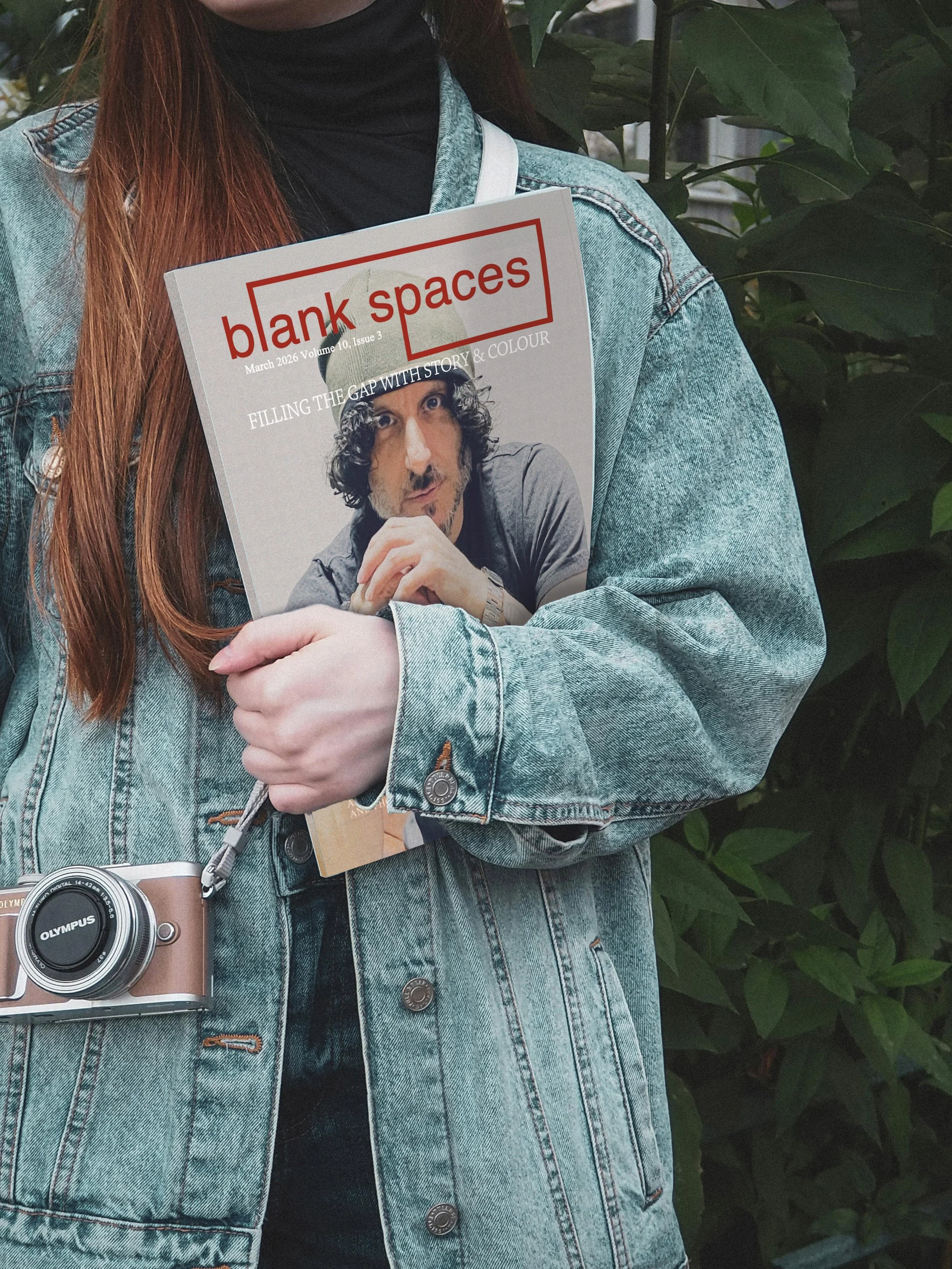
The complete table of contents as it appears in the March 2026 issue of Blank Spaces.
from the editor—Confessions from a Dreamer
shameless—Amy Boyes navigates the tender, bewildering geography of uprooting a life in her creative non-fiction piece, Four Seasons. More than a story about moving, it is a meditation on belonging—what we plant, what we carry, and what we grieve when we leave.
—Through her personal narrative, Post-Modern Mobility, Justine Leonhardt explores the strange disorientation of stillness after a life in motion. Returning to Vancouver after months of wandering, she finds that settling down is its own kind of unmooring—the imperfections of a new apartment becoming a canvas for all the ambivalence of choosing one life over the endless possibility of another.
—Katie DeBoer enters the classroom with clear eyes and hard-won honesty in her personal essay, Luke. A portrait of one student and the year he hijacks, it is also something larger: a reckoning with the limits of patience, the myth of the problem child, and what it costs to choose connection over contempt.
flash fiction—In Balancing the Books, George Zancola writes with gleeful, elastic absurdity. A teenage boy rehearses book-carrying in front of a mirror and seeks a little brother’s solemn endorsement—and somehow, in that small, ridiculous theatre of longing, captures something true and tender about the terrifying first steps toward love.
—Pauline Shen conjures a delightfully unruly world in her short fiction, Word Processor. When a mysterious typewriter arrives at a couple’s door and begins granting whatever it spells, what unfolds is a fizzy comedy of typos and consequences, fuelled by one man’s credulity and one woman’s willingness to run with it.
—Sharp comedy unfolds in the corridors of power in Loyal Opposition, John McPhee’s short story. Played out almost entirely in dialogue, it is a portrait of a prime minister who is pompous, self-contradicting, and—despite himself—rather charming, and the quietly long-suffering chief of staff who has clearly been doing this far too long.
red solo cup—Two poems by Yvette LeClair arrive in quiet conversation with each other. In Food, desire unfolds through the sensory act of eating—an olive crushed between teeth becomes a meditation on hunger, mystery, and the body’s deeper appetites. In Train Station Double Take, a stranger’s face triggers a sideways elegy about grief, recognition, and the lengths we go to remain knowable to those we love.
—Dust from Decades gives voice to something unsettling and tender—the accumulated grime of a life lived too fast, watching from the bottom shelf as the years pile up and the house grows quiet. Its companion piece, Tiny, opens outward into longing and light, finding in a glimpse of small houses across water a communion the speaker has been searching for without quite knowing it. Together, Spencer Gorham’s two poems trace the distance between what we neglect and what we reach toward.
—Louie Leyson writes with lyric intensity and formal daring in two poems that circle each other like twin wounds. Love Has Torn Us Apart Again fractures and reassembles itself on the page—a poem about the disorienting recursion of love and shame, where time folds back on itself and forgiveness is something you wait your turn for. Isaac on the Altar descends into the body’s oldest hunger, reimagining the biblical bind of sacrifice and devotion as something achingly physical— a boy starved enough to forgive everything, even the hand that bound him.
fiction—A gas station on the edge of nowhere becomes the unlikely stage for Moths & Men, Stephanie Silk’s fiction—a slow-burn thriller that keeps its hand hidden until the very last moment. Written with sharp wit and cool nerve, it is the story of a woman passing through, a town briefly upended, and the delicious revelation that in a room full of people running from something, not everyone is who they seem.
—Twice Born is a story that earns its title. James Monroe traces one man’s long war with the weight of being alive—the therapy, the travel, the careful building and quiet unravelling of a conventional life—with unflinching honesty and without easy consolation.
—Sky holds its reader in a state of dread and tenderness in equal measure. Sarah El Sioufi writes postpartum intrusive thought with rare precision and courage—the isolation of a rural winter, a body that no longer feels like one's own, and a mind that will not quiet. The redemption, when it comes, arrives without fanfare.
food of love—A poem that needs no explanation and earns every smirk. Leslie Stark turns the unglamorous business of band rehearsal into something gleefully suggestive in Stuff People Say at a Band Rehearsal That Sounds Kinda Dirty—proof that the most effective comedy is often just a matter of paying attention.
different strokes—Toronto-based artist Al Gord brings his industrial mixed media pop art to the pages of this issue in Art for the Rebel Soul—a vibrant tribute to rock music culture and the icons who shaped it. What began as personal therapy has become a fearless body of work that translates sound, rebellion, and raw emotion into layered visual form. These are paintings that refuse to be quiet.
between the lines—Gail M. Murray brings us a review of Proof by Beverley McLachlin, former Chief Justice of the Supreme Court of Canada.
write prompt challenge winner—Julia Edda Pape presented a strong contest entry with her short fiction Trespassing, one that the judges called “vivid” and “controlled.”
final word—Nora Duffy’s personal essay, Devil’s Playground, finds philosophy in the mundane and makes a quiet, convincing case that the most unglamorous kind of productivity is sometimes the most necessary. Funny, honest, and sneakily wise about heartbreak and self-knowledge, it is the kind of piece that lingers long after the last page.