What We’re Talking About in Issue 1101 (September 2026)
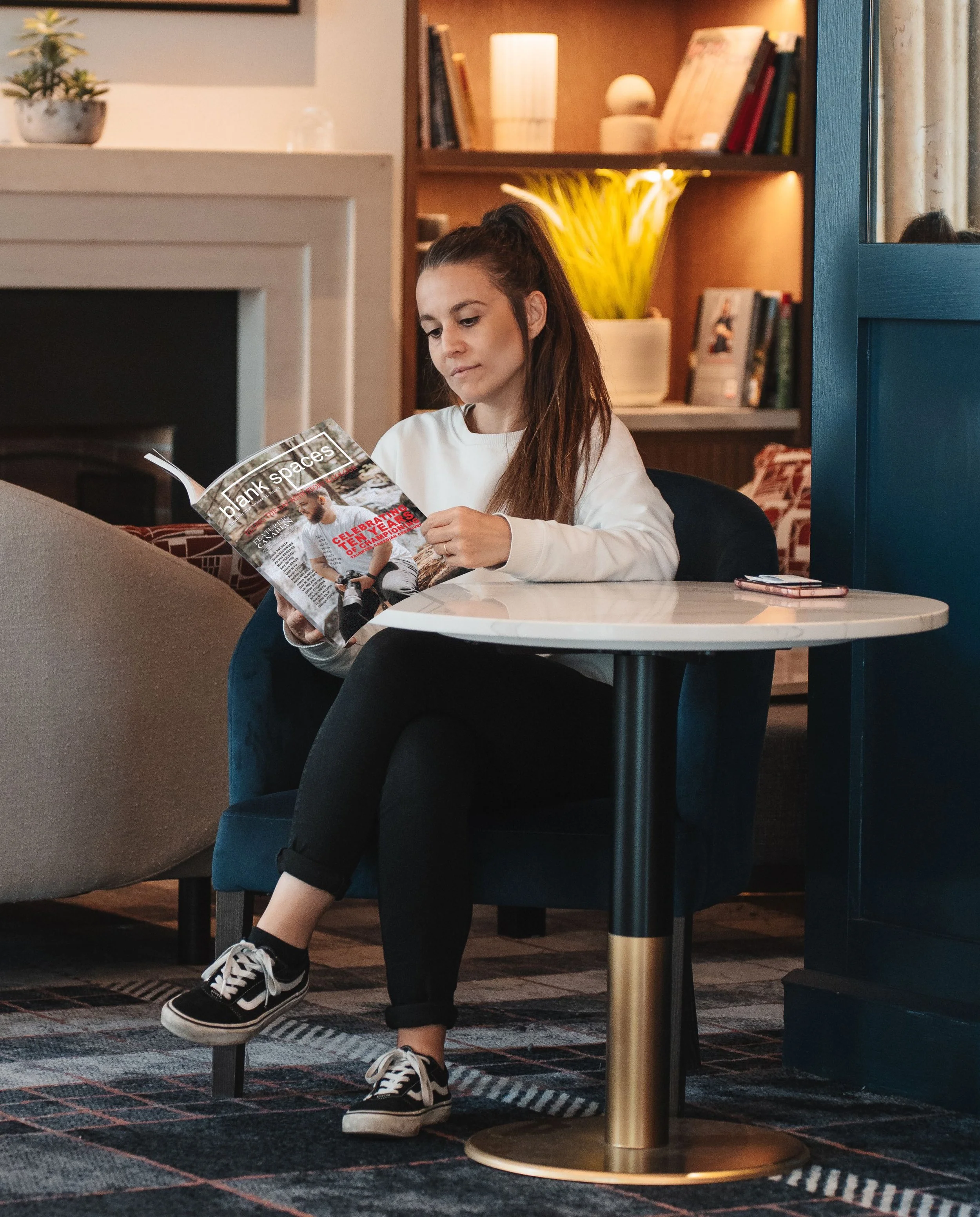
The complete table of contents as it appears in the September 2026 issue of Blank Spaces.
from the editor—”I Want to Start a Magazine”
shameless—Do You Have Anything to Declare? by Justin Ancheta takes to the air with a pilot’s precision, navigating turbulence that has nothing to do with altitude. Between layovers and loaded questions, this piece charts what it means to hold your ground when the world keeps asking you to explain yourself. A meditation on belonging, delivered with a steady hand on the yoke even as the engines run hot.
A reckoning with the stories we tell to protect ourselves and the ones we finally stop telling. Kris M. Webb’s About That Night moves through a relationship unravelling in slow motion toward the quiet act of reclaiming a self that had gone missing inside it.
A wandering meditation on place and belonging, Jacob Braun’s From Nothing follows a lakeside walk through Burlington’s shifting light—haiku fragments threading between condo cranes and cherry blossoms. What begins as ambivalence toward a neighbourhood settles, almost without permission, into something like love. A gentle study in how a place becomes a home.
flash fiction—Sharp-edged and unflinching, Another Day at the Office by James Monroe turns the intersection panhandler into an unlikely anti-hero—one who understands the transaction of pity better than anyone rolling up their window against him. There’s dark comedy here, and something more uncomfortable beneath it: a study of dignity performed on someone else’s terms, and who really controls the exchange.
Cool, cunning, and patient—Sarah Krawat’sWhispers from the Dark gives voice to the thing under the bed, tracing its slow claim from an unsuspecting parent’s room to a child’s, one who still knows how to be afraid. Told entirely from the predator’s point of view, this is horror stripped of jump scares and left with something colder: the quiet, generational handoff of fear itself.
The Voice by Amy Boyes traps its narrator mid-flight beside an inescapable monologue—one woman’s relentless catalogue of grievances against daughters-in-law, vegetables, and the softness of modern parenting. What starts as comic irritation curdles into something quieter: a portrait glimpsed between airplane seats of a life that calcified into complaint. Sharp-eared and wry, it’s a small, devastating snapshot of loneliness disguised as opinion
red solo cup—Jacob Lee Bachinger’s poems move between kitchen windowsill and open field, finding kinship in things that strain toward what they can’t reach. Consider the Sunflowers turns a son’s blizzard rescue into a small, stoic hospice; We Remain Neolithic unearths an ancient pulse of harvest in a handful of grain by the railway tracks; and Thanksgiving Cactus sits with a coyote’s thwarted hunger as closely as it sits with a flower’s. Patient and quietly devastating, these poems offer three meditations on longing and its limits.
fiction—Imposters by Jack Stilborn puts a fictional MP in the therapist’s chair; or rather, opposite it, where he unravels his own performance one session at a time. Martin insists he isn’t suffering from imposter syndrome; he simply is an imposter, voices borrowed and worn like a second skin, right down to the Mulroney cadence that won him a schoolyard debate. Sharp, funny, and a little unsettling, this is a story about the selves we assemble to be believed, and what, if anything, is left underneath.
In the instant between trigger pull and death, a man drifts into a surreal blue afterworld—populated by a mathematician grandfather, his tiny fierce granddaughter, and a doorkeeper whose tears might be the only way out. Glenda Fu’s Lucid Blue draws on myth at every turn: an Atlas bowed under memory’s weight, figures caught in Sisyphean loops of futile repetition. Grief and hallucination blur into a fever dream of survivor’s guilt in a story that is harrowing, inventive, and never losing the wound underneath it.
A highway shoulder becomes the site of inherited crisis in Ronald Zajac’s The Devil’s Rock Cut, where a teenager’s psychotic episode collides with generations of family superstition. Nathan’s flight toward a stolen mile marker becomes a father’s desperate pursuit through rock and rushing traffic, hockey-rink language standing in for the language neither of them has for what’s happening. Unsparing about mental illness without flattening it into metaphor, this is a story about the stories families tell to survive what they can’t explain.
different strokes—James Portman’s Reimagining the Bay returns again and again to a landscape he knows so well—every canvas rooted in a real beach, river bend, or trail along Georgian Bay’s southern shore.
impact statements—Read the testimonies of past Blank Spaces contributors and learn how the magazine has played a role in their creative career over the past decade.
food of love—La Banda Americana by George Zancola finds 16-year-old Sam cobbling together broken Italian to reach his grandmother across a language he barely speaks—desperate to name a longing his father forbids. Between a stone mason’s fury and a Grateful Dead tour he can’t afford, this is a story about the words we invent when the right ones don’t exist in either language we’re given.
story matters—A Voice Returned braids two unravelling memories into one. vic osland moves between a grandmother sliding into dementia and a partner sliding into drink, both slowly losing the thread of what came before—and writing itself becomes the only container sturdy enough to hold it. Fragmented, clinical, and lyric by turns, this is a piece about what memory owes to language and what language salvages when memory fails.
more than words—Cedar, Skies, and Deep Breaths finds photographer Brayden Wilson chasing the feeling of a place as much as the place itself, each image an attempt to hold onto a breath before it passes. Wilson moves through nature and storytelling as a way of processing joy and trauma recovery, neurodivergence, and life as a trans person in the world, and it shows in the tenderness of his approach, and the sense of images taken not to document a place but to keep it in the lungs.
between the lines—Gail M. Murray brings us a review of One Golden Summer by Canadian author Carly Fortune.
write prompt challenge winner—Andrea Bernard presented a strong contest entry with her short fiction Centre Stage, one that the judges called “unique” and “poignant.”
final word—Meaning by Bella Melardi closes the issue on a reckoning—a prose poem that moves through body image, self-loathing, and the exhausting loop of comparison toward something harder-won: the decision to stop running the same track. Melardi doesn’t offer easy resolution, just clear-eyed presence—meaning found in how you treat yourself, in the art you make, in the voices you lift up. A fitting final word: vast, beautiful, and ever-evolving.