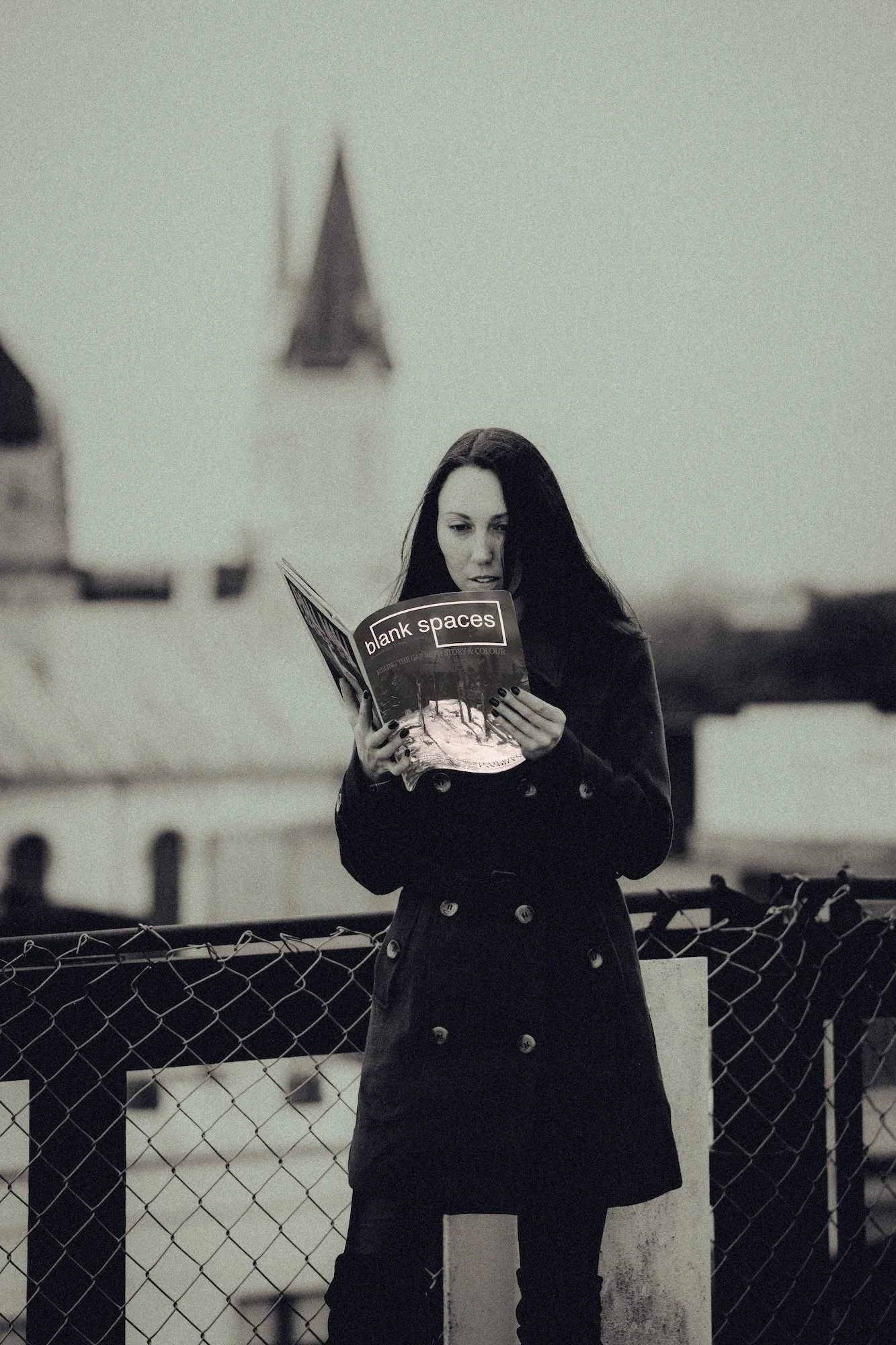
The complete table of contents as it appears in the December 2026 issue of Blank Spaces.
from the editor—”The Long Game”
shameless—Wry and unhurried, Death, Rutabaga, and the Friends I Used to Know by Mazen Maurice Guirguis holds two kinds of loss side by side: the clean finality of death, and the quieter, more confusing fading of friendship. It’s an honest reckoning with the bonds we assume run both ways, and with the bitter symmetry of becoming someone else’s ghost.
In A Life Outside of Treatment, Daphnée Lévesque writes about the therapist who wouldn’t look away, with candour, dark humour, and hard-won tenderness. It’s a portrait of a relationship built on tough love and stubborn bargaining, and of the quiet, rarely acknowledged grief of losing the person who helped you choose to stay.
flash fiction—Unease seeps in like cold rain in November by Catherine Austen, a taut, quietly chilling look at trauma, memory, and the gap between who we are and who others need us to have been. Retrained to the last line, it asks what we owe the people who remember us as more than we were.
Every polite smile is a calculation in The Subway by Madison Dillon, a tense, claustrophobic study of politeness as self-defence and the constant watchfulness of a woman travelling alone. Dillon tightens the dread with every step and saves the coolest moment for last.
George Zancola blends prose and verse in Nowhere Town/Angel’s Room, a bleak, lyrical portrait of loneliness and the stories a drinker tells himself about getting out. The poems are scrawled on bar napkins between last calls, and they reach for something luminous in the wreckage, even as the man writing them insists the world is his oyster.
red solo cup—Searching runs through both of Adrienne Weiss’s poems. Your Shoes whips grief into a fairy-tale storm on crows and thorns, where a sister left behind hunts for a way out, while Cold Case slows into a quieter elegy for youth and the gleaming futures we once took for granted. Together they sit with absence, and with everything we will leave unsolved.
There is a sly defiance in Fynne Goldstein’s poems, which make the self both refuge and tormentor. Therapy Session floats out of the speaker’s head only to find the Quiet harder to live with than the Noise, while I Know a Look of Mockery catches the speaker’s own shadow grinning back with schoolyard derision.
fiction—A reluctant son trails a mother set on finding magic along the Camino de Santiago in Et Suseia by Pauline Shen, a funny, warm-hearted story about good intentions working at cross purposes. Somewhere between blistered yes and a sunrise, the pilgrimage he joined for her starts to look like his own walk.
Grief drains the colour from everything in Black Rhapsody by Peter C. Conrad: a painter’s once-bright canvases have turned to black, and her brother keeps reaching for a childhood she insists belongs to writers, not painters. Slow-burning and painterly, it’s a story about memory against the present moment, and about the guilt, anger, and love that stay hidden in the dark until you step close enough to see them.
Smile! by Ingrid Keenan follows a teenage girl through a day of small, relentless indignities, from the dentist’s chair to the city sidewalk, and then down into a ravine where the old stories start to shift. Sharp, darkly funny, and simmering with rage, it’s a fairy tale retold for every girl who has been told to smile, and a satisfying reckoning with who the real predators are.
different strokes— In Absinthe & Ink, Amanda Gallagher paints memory into place. Her Canadian landscapes and rural scenes are paired over spray-paint abstraction, with soft-edged subjects that dissolve into the background or stand against it. Rooted in deep research and made wherever her easel lands, her work invites viewers to step into another place and time.
food of love—A Johnny Mathis song opens the door to a 1960s New York childhood in Joey by Miriam Edelson: baseball in the street, Shea Stadium bleachers, and the older boy next door every kid adored. Written from the far side of a move to Canada, this affectionate look back shows how one song can carry us across a border and sixty years to the place, and the people, where we began.
story matters—Dickens gets a fond farewell in Your Verbs Are Showing by Rhonda Skinner, a playful, self-deprecating look at unlearning the habits we once thought made our writing classy. Port confession and part craft lesson, it’s a cheerful case for strong verbs, precise modifiers, and the humility to let a favourite adverb go.
between the lines—Gail M. Murray brings us a review of Adrienne Chinn’s novel, Love In A Time Of War.
write prompt challenge winner—TBD
final word—Brayden Wilson closes the issue in the restless hours after midnight with Starlings, a haunted, rhyming lullaby about grief, sleeplessness, and a mind rewired by the past. Drifting between bathwater, window, and memory, it makes a tender final word: the strange comfort of answering, in sleep, a call we can’t answer awake.