What We’re Talking About in Issue 1004 (June 2026)
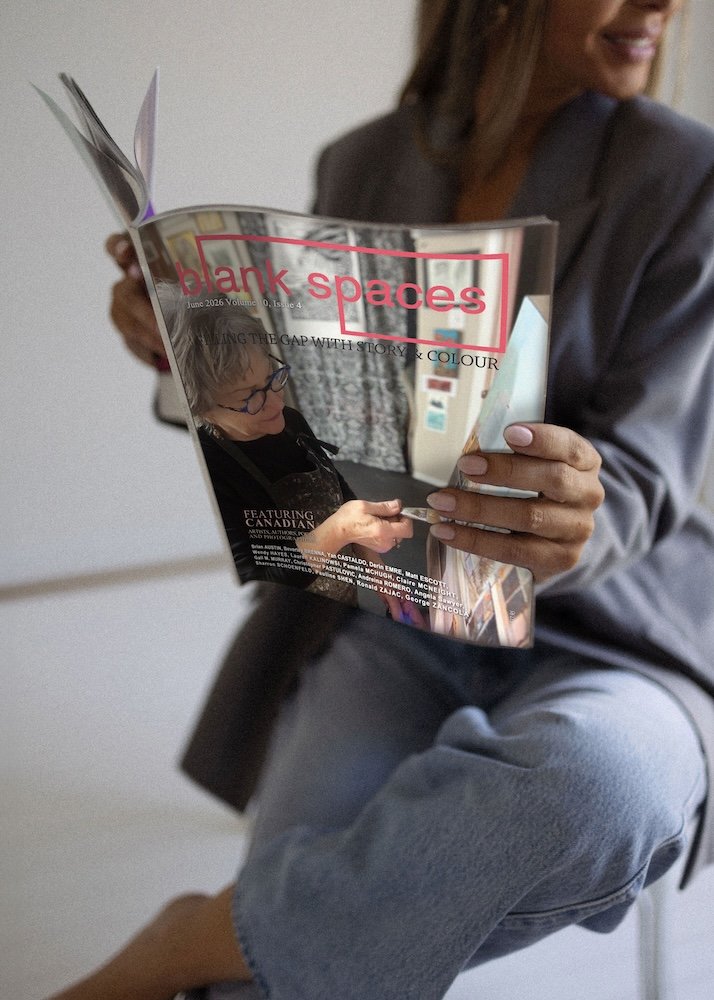
The complete table of contents as it appears in the June 2026 issue of Blank Spaces.
from the editor—Big Sister Energy
shameless—Yan Castaldo confronts the violence of ordinary objects in his creative non-fiction piece, i flinch when i see aluminum bowls. More than a story about loss, it is a meditation on the body’s memory—what it witnesses, what breaks, and what refuses to forget.
Through her personal narrative, Cold Plunge, Claire McNeight finds that female friendship, the kind that holds your silence and earns your truth, can take root in the most unlikely of places.
In The Healing Place, Wendy Hayes discovers that the imaginary landscape she painted as a child was real all along—and that it had something to offer her she didn't know she needed.
flash fiction—In Bake Sale, Derin Emre finds an entire world inside a Friday night at the YMCA—where Persian sweets, bamboo steamers, and paper cups of tea become the unlikely architecture of belonging for people who are all, in one way or another, far from home.
Brian Austin turns a bad back into a comedy of domestic power in Patent Pending, a story told with a wink, in which a wife’s clinical eye and a husband’s aching anatomy conspire to get the lawn mowed at last.
red solo cup—Matt Escott’s trio of poems, A Loud Wailing Throughout Egypt, Mystery, and The Only Way Out is Through, are meditations on what we inherit, what we pass on, and what it costs to live inside a mind that will not stay quiet.
Lauren Kalinowski moves through the full range of love and its absences in three poems—from the lit-up eyes and hand-pumping joy of That, through the restless, medicated hours of Insomnia, to the quiet devastation of The Potted Plant, where neglect has the last word.
fiction—In Creep, Pamela McHugh sets a girl’s longing against the slow, terrible education of knowing better—a story soaked in the nineties, in hero worship, and in the particular cruelty of learning that the boy you’ve cast as your leading man never considered you part of his story at all.
George Zancola’sGrieving Jane Bowes is a quiet, unglamorous portrait of loyalty, loss, and the particular grief of mourning someone you realize you never knew as well as you claimed.
food of love—In Vinyl, Ronald Zajac traces a man’s fragile inner life through the songs that have always lived there. A tender story about homelessness and mental illness, where a half-remembered lyric from a 1983 record becomes the thread connecting a boy who once received it as a birthday gift to the man still carrying it, decades later.
different strokes—Sharron Schoenfeld paints the way a poet writes: with attention to what others overlook and conviction that the ordinary deserves to be honoured. Her Urban Poetry series brings that same quiet devotion to Saskatoon’s oldest buildings, finding in their rooflines and facades not just architecture, but the accumulated light of lives well-lived.
story matters—Andreina Romero dismantles herself with a dictionary in Non-Fiction: A Glossary, a raw, searching essay about a BPD diagnosis, the fear that desire itself might be a symptom, and the terrifying question of whether the woman who has always wanted to write ever really existed at all.
With the grounded pragmatism of someone who has worked in classrooms, gyms, and offices, Pauline Shen makes a compelling case that the commuter workforce has plenty to teach the work-from-home writer in Five Effective Practices from the Commuter Workforce That I Use as a Freelance Writer.
make art not war—In Words and Images: A Partner Dance, Beverley Brenna invites us into creative conversation between her acrylic wetland paintings and the contemporary haiku that live alongside them—two distinct art forms that, like good dancers, mean more together than they ever could alone.
between the lines—Gail M. Murray brings us a review of Finding Flora by Canadian author Elinor Florence.
write prompt challenge winner—Angela Sawyer presented a strong contest entry with her short fiction Itch to Cut, one that the judges called “rich,” “vivid,” and “sensual.”
final word—Even as the boards crack and the gale rises, Christopher Pastulovic’s Get Beside Me, Bright One insists that you tighten your grip, make yourself lighter, and keep moving toward the light.